International Ayurveda Conference
Held during the 2001 Maha Kumbh Mela at Allahabad with delegates from India and abroad.
आयुर्वेद विश्व परिषद (पंजीकृत) · Registered Body

आयुर्वेद विश्व परिषद
World Academy of Ayurveda
An all-world body for the Ayurvedic community · Est. 12 January 1957, Kurukshetra
Prepared by Dr. Acharya Prabhakar Mishra, Founder and First President of the World Academy of Ayurveda.
The founder’s English text · Book 2
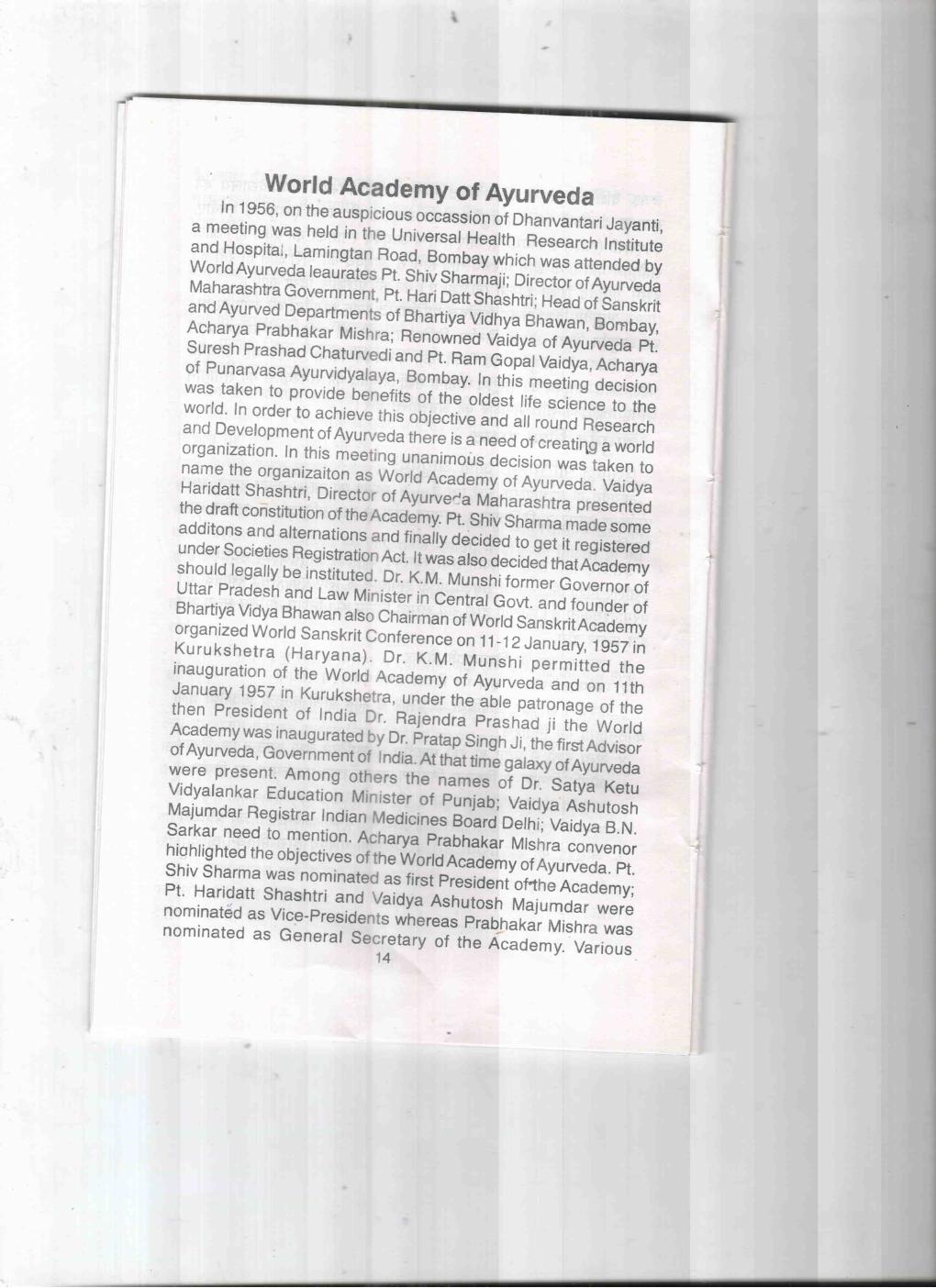
On Dhanvantari Jayanti in 1956, a meeting at the Universal Health Research Institute and Hospital on Lamington Road, Bombay, brought together leading figures in Ayurveda. Their shared decision was to carry the benefits of this ancient life science to the world through a global organisation devoted to research and development.
The meeting unanimously adopted the name World Academy of Ayurveda. A draft constitution was presented, refined and marked for registration under the Societies Registration Act. Acharya Prabhakar Mishra, as convenor, presented the Academy’s objectives.
Book 2 records the Academy’s inauguration at Kurukshetra during the World Sanskrit Conference. Its continuing purpose is to take Ayurveda to every corner of the world, develop branches, encourage international conferences and bring the science of life into the mainstream of world science.
The founder’s record calls upon every vaidya and well-wisher of Ayurveda to cooperate in this endeavour and strengthen the Academy through membership and participation.
11 archival pages: founder profile, history, objectives, achievements and Ayurveda Sena.
 English selection only
The published mission
Professionally typeset from the founder’s English text, preserving the purpose and scope of every published objective.
Present Ayurveda as a life science for the welfare of the world and build a broad organisation of Ayurvedic physicians, lovers and well-wishers.
Share general knowledge of Ayurveda worldwide through examinations, international travel and literature, and establish Ayurveda centres around the world.
Consolidate Ayurvedic literature into a world Ayurveda code and publish it in multiple languages.
Establish a World Research Institute of Ayurveda, hospitals, a world medical university and libraries, and develop Ayurveda cities.
Organise camps, seminars, conferences, anniversaries, festivals, lectures, felicitations, awards, Ayurveda fairs and exhibitions.
Protect the basic principles of Ayurveda, encourage comparative study of medical systems and maintain cordial relations with contemporary medical sciences.
Establish workshops for Ayurvedic instruments, pharmacies, Ayurvedic housing societies and Dhanvantari cooperative banks.
Hold Prithvi Sammelans and Srishti Sammilans to support environmental purification.
Establish Ayurveda Bhawans in every state and run Ayurvedic village-development projects.
Create an Ayurvedic Development Fund for scholarships and assistance, produce standard Ayurvedic books, and publish magazines at governmental and non-governmental levels.
Affiliate Ayurvedic organisations wherever development needs are identified.
Advocate fair government pay scales and grants, Ayurvedic cells in general hospitals and faculties in universities, and stronger Ayurvedic education and research.
Undertake work that advances the interests and welfare of Ayurveda and help resolve issues facing the field.
Advise governments on curricula, budgets and services; advocate dedicated leadership for Ayurveda; and recommend experts for official committees and delegations.
Form a consortium of Ayurvedic pharmacies, provide scientific assistance and support exports and recognition in international markets.
Appoint an Ayurvedic Ambassador in each country to engage governments and establish Ayurvedic treatment and Panchakarma centres.
Establish district-level presidents and committees across India to popularise Ayurveda.
Promote Yoga and Naturopathy alongside Ayurveda.
Conserve rare, endangered, threatened and endemic medicinal plants through ex-situ and in-situ herbal gardens.
Establish an Ayurved Nagar in every state.
Establish Dhanvantari Patanjali University for research and education in Ayurveda, Yoga and Jyotish, including distance learning for international students.
Recommend financial assistance for Ayurvedic graduates, postgraduates, colleges and herbal gardens.
Constitute a Global Ayurved Parliament of eminent scientists, Ayurvedacharyas, Yoga experts and alternative-medicine experts, with a health-care fund for a disease-free world.
Educate communities through Ayurved Yog Raths about medicinal plants, disease-free living and healthier lifestyles.
Celebrate Dhanvantari and Patanjali Jayanti in educational and religious institutions and organise national celebrations and free Ayurvedic health camps.
Establish herbal gardens in schools, colleges, universities and public gardens.
What the Academy had achieved
Held during the 2001 Maha Kumbh Mela at Allahabad with delegates from India and abroad.
Eminent vaidyas were honoured at Siri Fort, New Delhi, and at a major programme on 8 August 2005.
A two-day national seminar in New Delhi brought together 250 delegates, 15 speakers and leading scientists in December 2006.
The Academy associated with the Global Yoga Festival and XV World Yoga Championship in New Delhi in 2006.
Free Ayurvedic camps were organised at Maa Bhuvaneshwari Temple, Bhondsi, Gurgaon, during religious observances in 2006.
Work began through cells for medicinal-plant cultivation, Rishi-Krishi and microbial biofertilisers, environment, world peace, Yoga and Naturopathy.
Ayurveda Sena
The English text calls for a united, organised movement to protect and develop Ayurveda, support its practitioners and students, and build a healthy world family.
Preserve health through ethical living, Yoga, Pranayama, Naturopathy and a clean environment.
Encourage safe, well-researched Ayurvedic care that addresses underlying causes rather than merely suppressing disease.
Bring practitioners, scholars, students and pharmacies together in service of humanity without self-interest.